1 in 65 Million Stats Explained | ค่าสถานะ
1 ใน 65 ล้าน · An unofficial English guide
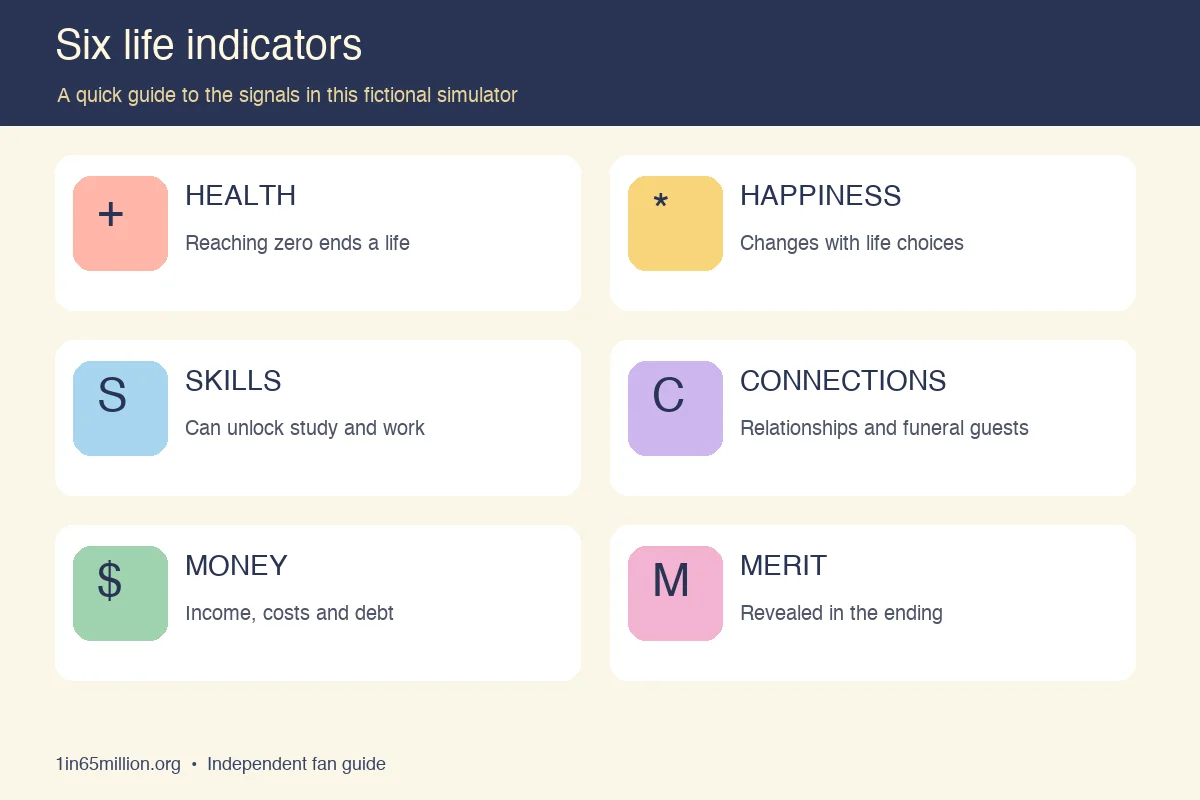
The reference game uses health, happiness, skill, connections and money to summarize a fictional life, with merit or karma tracked separately and revealed later. This independent game displays its main attributes and debt while keeping merit hidden until the life ends. Read each change in the context of the version you are playing.
Last updated:
Health and survival
Health represents the character's physical condition. On this site it is bounded from zero to 100, and reaching zero ends the life. Some choices reduce health in exchange for learning, income or connections; other choices can restore it. The health number is a game mechanic, not a medical measurement or a recommendation about real treatment.
Think about the margin between the current value and zero. If the character has already lost health, an option that costs health carries more immediate risk than it did at the start. A short-term advantage may not be useful if the life ends before the next major decision. Not every future event is visible in advance, so a buffer can matter.
Health is not the only ending condition here. Each life also receives a fictional end age. A healthy character can therefore reach the assigned age, while a character whose health falls to zero can end earlier. There is no sequence that guarantees the same lifespan for every newly generated life.
Happiness and wellbeing
Happiness is a separate measure from health. A choice can improve one while reducing the other: a demanding role may bring income but leave less time for rest, while spending time with friends may improve happiness without changing earnings. Check the effect line beneath a choice rather than assuming that “good for career” means “good for every stat”.
In the independent game, happiness is displayed and affected by choices, but it should not be described as a clinical score. It represents the state of a fictional character. The reference may attach different consequences to low or high happiness, and updates can change its event rules.
When reviewing a life, use the life log to identify repeated trade-offs. Did the character select several demanding activities without a break? Did family or community choices provide support? These questions help you understand a particular playthrough without claiming that one metric explains every outcome.
Skill and education
Skill, shown as ทักษะ in our Thai interface, changes with education, activities and events. In our career selector, some jobs require a minimum skill level. The screen shows the requirement when the option is disabled. Other careers require a specific training route instead, so skill alone does not open every path.
Education choices also have costs. A more expensive route can change skill or connections, but the corresponding debt can affect the rest of the life. Compare the starting balance with the fee and look at the resulting debt, not only at the positive attribute change. The school and career guide walks through that decision.
The reference game may use skill in additional ways, including study and earnings. This site's career calculations use a specific implementation of salaries, career outcomes and prerequisites; do not assume that a reference-game formula applies unchanged here.
Connections and money
Connections describe social ties. The Thai reference may use เส้นสาย, while our interface labels the attribute ความสัมพันธ์. On this site connections affect some events, a political election's fictional chance of success and an ally action in the magic encounter. Career and community choices can change the value.
Cash and debt are shown separately in our version. When an expense exceeds available cash, the shortfall becomes debt. As years advance, living costs are deducted and loan interest is applied; some positive net income can repay the debt. Monthly income is therefore not equal to the amount saved each year.
The reference game uses its own financial model and may show a negative balance differently. Its connections can also influence the number of people attending a funeral. In our ending, connections and the chosen ceremony affect the number of funeral guests. Learn the relevant interface terms in the translation guide.
Merit and version differences
The reference game's merit or karma is a hidden dimension of conduct that can be revealed later in a life. Because it is hidden, the player should not assume that every visible benefit is the complete result of a choice. The original's own current descriptions and ending screens are the best way to observe how it reports merit.
Our independent game now records hidden merit for selected actions and reveals it with a ledger at the end. A police character can also choose a conduct path and repeated misconduct can lead to dismissal. These are independent mechanics and do not reproduce every consequence in the reference game.
Both games now include funeral choices and merit, but their stories are not identical. Our endings and merit guide labels those details. To see what this site actually tracks, start a life and inspect the status bar and life log; the guide index contains more version-specific help.
Example: reading a mixed outcome
Suppose a choice offers extra income while reducing health and happiness. Before deciding, check the character's current health, whether there is outstanding debt and how far away the next major event is. The income might help meet future costs, but it does not automatically repay a health loss. Another choice may preserve wellbeing while producing less income.
After selecting, read the result and compare the visible values. If the balance rises later, remember that the game also applies living expenses and debt interest as years advance. A positive number on the income line is not the same as a positive net change in cash. The life log can help you connect the outcome to the decision without reconstructing every number from memory.
This is a hypothetical example for our game, not a claim about the reference's exact formulas. Both games use hidden merit and funeral-related connections, though their specific events and outcomes differ. Always check the version named in a guide when a described result is missing from the screen.
The timing of a change matters as much as its size. A choice's displayed effect is applied when you select it, while money and debt can also change as time advances between events. In a long gap, a player may see a different cash balance even without selecting another explicit purchase. The financial model and the event are separate sources of change.
A label can also represent a broader idea than a single real-world measure. “Connections” is an abstract game attribute; it does not quantify the value of an actual person's relationships. “Skill” is a game gate, not an assessment of a real person's intelligence. Treating the values as fictional makes it easier to explore the choices without turning the simulation into a claim about people.
Frequently asked questions
What does 1 ใน 65 ล้าน mean?
It means “one in 65 million”, the Thai title associated with the life simulator.
Does health reaching zero end a life here?
Yes. In this independent game, a health value of zero ends the current fictional life.
Is merit visible in this game?
Merit is hidden during the life and revealed in the ending, along with a ledger of recorded actions.
Does salary equal savings?
No. Our game applies living costs, debt interest and possible repayments as time advances, so income is only one part of the balance.
Do connections control funeral attendance here?
Yes. In this game, connections and the selected farewell influence the number of guests.