1 in 65 Million School and Career Guide | โรงเรียนและอาชีพ
1 ใน 65 ล้าน · An unofficial English guide
The best school and career in 1 in 65 million depend on starting resources, qualifications and the story you want to explore. Compare immediate costs, debt, entry requirements and health rather than choosing the option with the largest displayed salary. This guide distinguishes our independent game's rules from those of the original reference.
Last updated:
School and family resources
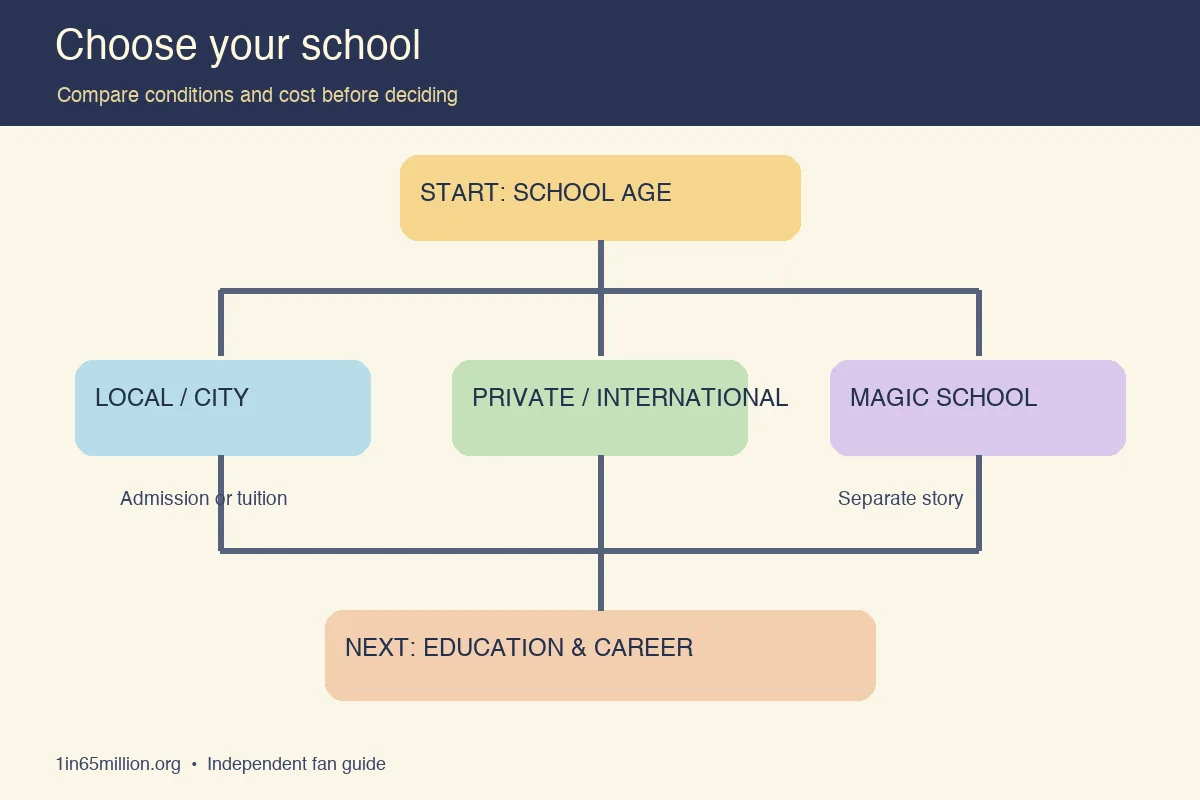
Begin by reading the birth card. Our game assigns a family background and cash, then presents schools with different costs and attribute effects. The background weights are fictional. Starting in a wealthy household creates more room to pay a fee, but it does not guarantee a good career outcome or a long life.
If a fee exceeds available money, the difference becomes debt in this site's game. This makes an expensive school available to a character with less cash, but the later burden is real within the simulation. You can compare two choices by looking at the fee, immediate attribute changes, remaining cash and debt after the selection.
There is also a magic academy. It opens a separate fictional story and career list rather than acting as a more expensive ordinary school. The reference game's magic branch is much larger than ours; use the crime and magic guide for the distinction.
Education choices after school
In the ordinary route on this site, the later education decision includes university, vocational training, entering work, police training, a sports programme and overseas study. Each has its own cost and effects. The important question is not simply whether the choice adds skill; it is whether it opens the kind of work you want and leaves a manageable financial position.
For example, police work requires the police-academy route here. A professional athlete or sports coach needs the sports programme, and an athlete also needs sufficient health. Office and civil-service roles require an eligible degree and a skill threshold. These are implementation rules of this site, not a promise that the reference game uses identical qualifications.
An early work choice starts income sooner, but some degree-gated roles will remain unavailable. Vocational training provides a different mix of costs and skills. University can open degree-gated work while increasing the amount borrowed if the family cannot pay. Review the disabled option's explanation on the career screen before deciding a path is broken.
Career entry requirements
The ordinary career list on our site includes police, sport, coaching, farming, factory work, civil service, office work, business, overseas work, underground work, politics and content creation. The magic route has five separate fictional careers. The current screen shows starting income and the game's possible career-outcome categories.
A career with no education requirement may still have an entry cost. Business, overseas work and content creation require upfront resources in this version. The game can turn a shortfall into debt, so the cost is not erased merely because the option can be selected. Use the stats guide to understand cash and debt.
Some paths offer special events. A police character can choose a conduct path and later consider a corrections transfer. Politics involves elections; losing an election means no elected salary until a later win. These branches are independently authored and do not reproduce all of the reference game's detailed career stories.
Income, risk, and debt
A high potential income is not the same as a guaranteed outcome. Our game assigns a fictional career trajectory, and the amount can grow or decline subject to that trajectory. The selection screen presents the game's categories so that the risk is visible. Treat the stated numbers as game mechanics rather than real Thai wage data.
As time advances, living costs, loan interest and possible debt repayments affect the balance. If a promotion increases income while reducing health, decide whether the character can absorb the immediate health cost. A less demanding choice may preserve room for later events even when its short-term income is lower.
The investment events on this site are deliberately risky: the displayed choice explains the share of cash at risk and the fictional chance of a return. Do not interpret that mechanic as investment advice. A game's high-risk outcome is not evidence about the real-world likelihood or suitability of an investment.
Planning a balanced path
Try making a plan before choosing a school: identify a possible career, check its training route, estimate whether the fee creates debt and reserve room for living costs. This does not require one perfect path. It gives you a reason to compare the options when the character's actual starting circumstances appear.
For a second run, change one major decision and compare the life logs. You could keep the same general objective but use a less expensive education route, or select a career without a degree requirement. Random starting conditions and events still differ, so the comparison is an illustration rather than a controlled experiment.
The reference game's career stories, probabilities and employment rules are broader than this fan version. For the basic controls see how to play; for the wider context see what the game is. You can start a life and return to the guide list after reviewing the result.
Three ways to compare a path
For a character with little starting cash, first compare the school fee with the available balance. If the shortfall becomes debt, note that amount before considering a later qualification. A cheaper school can preserve cash, while a more costly one may provide different immediate benefits. The screen shows the effects for the current version.
For a character aiming at police work, the later police-academy route is a specific prerequisite here. Check skill as well, because meeting the education condition alone is not enough when a skill threshold is shown. For a character aiming at sport, choose the sports programme and keep an eye on health before the career decision.
For a player who wants to explore rather than optimize, try a career whose story interests you and read its specific events. Record whether the occupation, income and wellbeing changed after a promotion or transfer. These examples show how to use the interface; they do not establish a universal best school, a guaranteed career outcome or a real-world salary comparison.
When a career card is disabled, read each condition separately. An education route, a skill minimum and a health minimum are different checks. Increasing skill through an earlier event will not substitute for the specific police or sports training required by the corresponding route in our game. Likewise, meeting a training condition does not automatically satisfy an additional health threshold.
After entering a career, watch for a change of role rather than assuming every later job decision preserves the same occupation. A promotion can keep the career, while a choice to change direction can leave it. Career-specific events depend on the current route, so switching can change which stories appear. The reference game's own career system contains additional branches beyond this simplified model.
Frequently asked questions
What does 1 ใน 65 ล้าน mean?
The Thai title means “one in 65 million”. It refers to a fictional life-simulation game.
Is the most expensive school always best?
No. Costs, debt, qualifications and other attributes all matter. Different starting conditions can make different choices reasonable.
Why is police work locked?
On this site the police career requires the police-academy education route and sufficient skill. The career card shows the condition.
Is the listed highest salary guaranteed?
No. Career outcomes are fictional and uncertain; a displayed potential does not promise that every character will reach it.
Are these real salary or investment recommendations?
No. The amounts and probabilities described for this site are game mechanics, not guidance for real education, employment or investment decisions.