1 in 65 Million Endings and Merit Guide | ฉากจบและบุญ
1 ใน 65 ล้าน · An unofficial English guide
A life in 1 in 65 million eventually ends, but the details depend on the version. The Thai reference includes hidden merit and funeral-related decisions. This independent game ends a life through health or an assigned lifespan, offers religion-specific funeral decisions, reveals merit and can continue through a child.
Last updated:
How a life reaches its end
On this site, health reaching zero ends the current fictional life. A character can also reach an assigned end age. The game generates that age as part of the life, so a high health value does not guarantee that the character will continue indefinitely. Neither mechanism predicts a real person's health or longevity.
The ending screen gathers the recorded decisions and smaller events into a life summary. Open the life log during play if you want to inspect the timeline before the end. The log is useful for connecting a financial or relationship outcome to earlier choices, but it is not a full transcript of every possible branch in the reference game.
A sudden ending can be frustrating when a character has invested in education or a career. A practical response is to review whether several decisions reduced health and whether the next attempt should preserve a larger buffer. The long-life guide explains this without promising a particular age.
Hidden merit in the reference
The Thai reference includes a hidden merit or karma dimension. It is associated with conduct during a life and can be revealed later. Because the score is hidden, a player should avoid claiming a precise effect for an individual action unless the current game itself explains it.
Merit is not a sixth visible bar in this site's independent game. Selected actions change a hidden score, which is revealed with a ledger at the end. Police misconduct can also have career consequences; the independently written events do not reproduce the reference's entire merit system.
The difference matters when comparing screenshots or asking why an ending looks different. Both games reveal merit later, but the events that change it are not identical. The stats guide identifies the attributes that our interface actually displays.
Funeral and remembrance choices
The reference game can include decisions about funeral observances, including the duration of Thai Buddhist chanting, and whether to donate a body for medical education. Connections may affect funeral attendance in that reference. Our independent ending also provides religion-specific choices, including body donation for a Buddhist character.
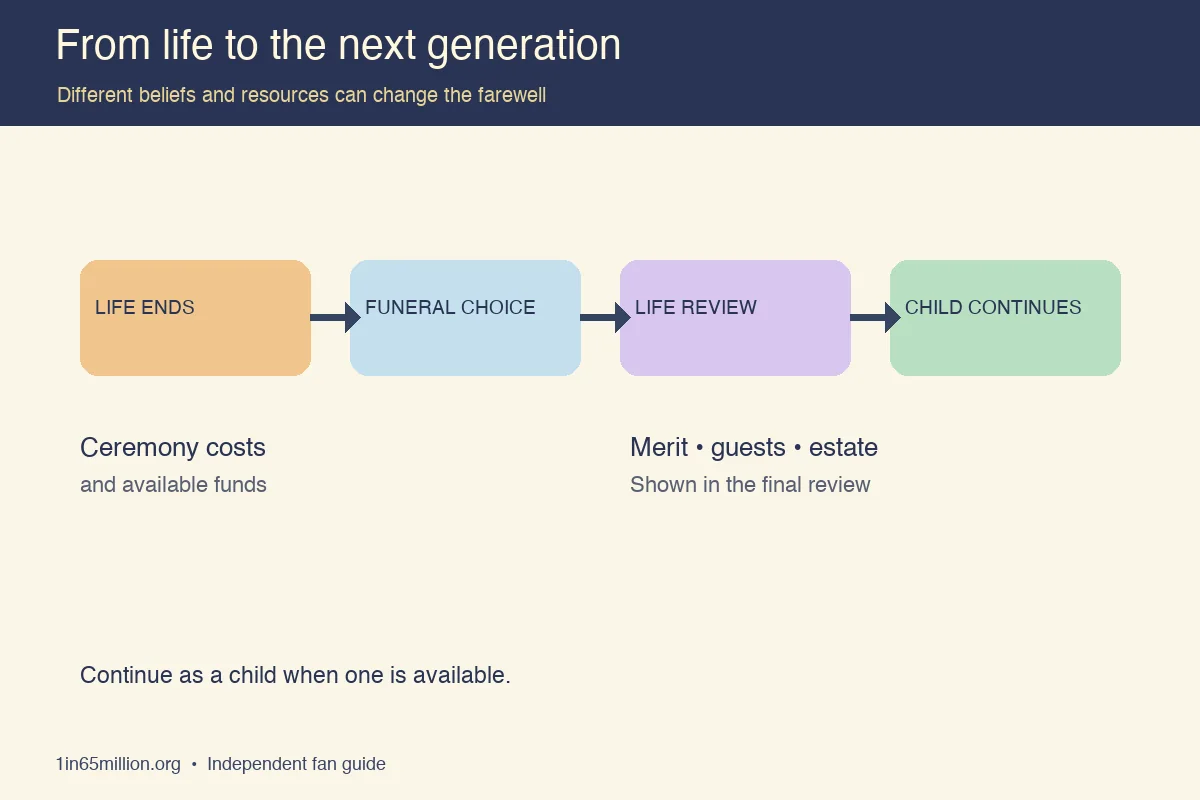
Our game offers several funeral arrangements and optional farewell actions before the recap. The chosen arrangement and connections affect guests and contributions; remaining money after costs and debt forms an estate. A child can continue the story when one exists.
Check the remaining cash before selecting optional funeral details; available extras must fit within the remaining budget. When discussing these events, treat the fictional story with care. A game compresses personal and cultural experiences into choices; it cannot represent every family's beliefs or practices. The terms and options shown by the actual reference can also change with updates.
Reviewing a life
A useful recap asks how the decisions interacted. Look at education costs, career entry, periods of debt, major changes in income and the points where health fell or recovered. Notice relationship and family decisions separately from financial results. A high final balance is one outcome, not a universal measure of a successful fictional life.
On this site, smaller-event results are also added to the life log. Election and investment outcomes can be recorded, and career events may follow earlier choices. The log summarizes what happened; it does not guarantee that a different run with a similar starting family will receive the same events.
If you want to compare strategies, write down a small question before restarting, such as whether a lower-cost education path leaves more cash for later choices. Since births and events vary, one comparison is illustrative rather than a statistical test. See how to play for the controls.
Continuing as a child
When a completed life on this site includes a child, the ending can offer Continue as your child. The new character begins in the same province and receives a share of the previous character's net estate after debt. A life without a child has no child-continuation option; you can still start a separate life.
The new generation is a new character with its own choices and assigned lifespan. It does not inherit every past event or reproduce the reference game's complete family system. If several children exist in a state, the estate is divided among them in this implementation.
The current life is saved to the account as you play. Sign in to the same account on another device to continue. The save guide and guide index provide more detail. You can start a life to explore a different route.
Questions to ask at the recap
Start with the cause shown by the version you played. In our implementation, the life ends when health reaches zero or the assigned lifespan is reached. The recap then lists decisions and event outcomes. It asks you to choose a funeral and then shows the hidden merit total and recorded actions.
Next, look at family continuation. If the character has a child, the continuation option starts a new fictional life in the same province and transfers a share of net cash after debt. If there is no child, the relevant option is to start a separate life. A new generation is not a promise that all past story flags will be carried over.
Finally, consider where the record is saved. An account stores one current life as you make decisions, and starting a new life replaces it. The original game’s accounts and ending options are separate. The two games have different displays and do not share accounts or saved lives.
The original reference's funeral choices and hidden merit are useful topics for a guide precisely because a player may not see all effects while making decisions. However, an unseen value is not a license to invent an exact formula. A responsible walkthrough can describe the presence of a hidden system and tell readers to inspect the ending without promising that a particular action always produces a specific score.
In our game, visible event results have a more limited scope. Police misconduct can lead to dismissal, and an election can be won or lost. Some choices also affect a hidden merit score, while other career outcomes do not. The ledger shows the actions counted by this version rather than claiming to reproduce every rule in the reference.
Frequently asked questions
What does 1 ใน 65 ล้าน mean?
It means “one in 65 million”, the Thai name associated with the life-simulation game.
Is merit tracked on this site?
Yes. Selected choices affect hidden merit, which is revealed in the ending with a record of those choices.
Can I choose funeral arrangements here?
Yes. The available arrangements depend on the character’s religion; some optional actions can be selected before the recap.
Can every life continue as a child?
No. On this site the child-continuation option requires the completed character to have a child.
Is the ending a prediction of real life?
No. The character, lifespan and outcomes are fictional game elements.